Tariq Rahman and the Return of Political Purpose
By K S T Qureshi
The political history of Bangladesh in the years preceding the student-led uprising of 5 August 2024 stands as a solemn study in the corrosion of democratic life. The government of Sheikh Hasina consolidated power through sustained suppression of opposition forces, with the Bangladesh Nationalist Party (“BNP”) and Islam oriented political movements bearing the harshest weight of state coercion. What unfolded was not merely partisan rivalry but a systematic narrowing of political space, enforced through arrests, intimidation, and the disappearance of prominent dissenting voices. The instruments of the state were deployed not as neutral guardians of order but as active agents in the silencing of opposition.
At the centre of this repression stood Begum Khaleda Zia, leader of the BNP and a towering figure in the political imagination of the nation. Her persecution was relentless, ruthless and public. Prosecutions were pressed with vigour, imprisonment followed, and humane considerations were conspicuously absent. Denied timely access to adequate medical treatment, her health deteriorated under custodial conditions that reflected a politics of vengeance rather than justice. Her death on 31 December 2025 marked the end of an era, closing the chapter on a leader whose career had been inseparable from the turbulent journey of Bangladeshi democracy.
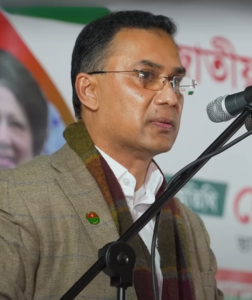
Her passing created an immediate and profound sense of uncertainty. In political movements shaped by personality and lineage, the absence of a central figure often invites fragmentation and decline. In the case of the BNP, the opposite occurred. The vacuum was filled with remarkable speed by Tariq Rahman, long regarded as the heir apparent but tested by years of exile and political adversity. His assumption of leadership did not resemble a hesitant inheritance. It appeared instead as a decisive taking of command at a moment of existential peril for the party. Tariq Rahman demonstrated an instinctive understanding of political timing and organisational psychology. With a deftness that surprised critics and supporters alike, he re-energised party structures that had grown fatigued under repression. His leadership conveyed confidence without theatricality and resolve without rhetorical excess. The BNP, often compared with a great vessel battered by storms, found under his guidance a steady hand at the helm. The sense of drift that had plagued the party gave way to renewed direction and discipline. This consolidation of authority was given formal expression on 10 January 2026, when Tariq Rahman was elected unanimously as Chairman of the Party, a development that affirmed his leadership and secured his command within the party’s organisational hierarchy.
This emerging authority has also been reflected in the conduct of the state itself. The present interim government has accorded Tariq Rahman full official protocol, a gesture widely interpreted as recognition of his central role in national affairs. In the political consciousness of the country, this protocol serves as a tacit acknowledgement of his position as the de facto prime minister of Bangladesh, underscoring the extent to which formal office has been anticipated by practical leadership. Political analysts have been quick to note the significance of this transformation. Many have expressed the view that Tariq Rahman is positioned to form the next government and to assume the office of prime minister. Such assessments are grounded not only in electoral arithmetic but in the symbolic power of his return.
Upon his return to Bangladesh from exile in the United Kingdom, he declared that he came with a plan, a statement that carried deliberate weight in a society shaped by long years of political chicanery. The declaration signalled intent, preparation, and a belief in purposeful leadership at a moment when uncertainty had become habitual. As part of translating this declared intent into political momentum, Tariq Rahman is due to visit Sylhet and Sunamganj on 22 January 2026 as a central element of his campaign. These visits are invested with significance that extends beyond routine mobilisation. Large sections of the population have lost confidence in democracy and in the electoral process itself, having witnessed staged elections repeated over previous decades, during which democracy was employed both as shield and as sword. The erosion of trust has been deep and cumulative, leaving many citizens sceptical of promises and wary of participation.
It therefore falls upon Tariq Rahman to reassure the electorate that democratic practice will be restored in substance rather than form. Central to this reassurance is his commitment that the election scheduled for 12 February will be free, fair and conducted on equal footing. Such assurances, however, will not be validated by rhetoric alone. They will be judged by the conduct of the process and by the level of public turnout, which stands as the most visible measure of renewed faith in democratic choice. Public anticipation now centres on the substance of this declared plan. People across social classes look towards the future with a mixture of hope and scrutiny.
The expectation is not merely of administrative change but of a deeper restoration of dignity and fairness in public life. The memory of what his parents sought to achieve looms large in this collective imagination. The idea that a new prime minister might seek to reshape the fate of the people through principled leadership evokes both nostalgia and aspiration. In this unfolding moment, Tariq Rahman stands at the intersection of inheritance and innovation. His challenge lies in translating personal legitimacy into institutional reform, and emotional loyalty into durable governance. The path ahead demands not only political skill but moral clarity. If he succeeds, his leadership may come to be seen as a turning point, when a party scarred by repression transformed adversity into purpose, and when a nation glimpsed the possibility of renewal through democratic resolve.