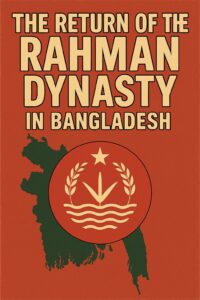
The Return of the Rahman Dynasty
By K S T Qureshi
On 12 February 2026 the people of Bangladesh delivered a decisive verdict at the ballot box. In the general election held on that date Tarique Rahman secured a near absolute majority and with it the mandate to form the next government. For many observers this moment represents more than a routine democratic transition. It marks the return of what supporters describe as the Rahman Dynasty to the centre of national authority. Tarique Rahman stands as the third generation of a political lineage that has shaped the modern history of Bangladesh. Before him his father served as President and his mother as Prime Minister. Now the responsibility of leadership rests upon his shoulders. The symbolism of succession is powerful in a political culture where memory and martyrdom carry immense weight. The dynasty traces its origins to Shaheed Ziaur Rahman. He entered politics during a period of profound instability when the state faced ideological turbulence and institutional fragility. The crisis of the era was defined by competing visions of national identity and economic direction. Shaheed Zia positioned himself as a restorer of order and a proponent of pluralist politics. With considerable resistance and personal risk, he initiated the reintroduction of multiparty democracy. His supporters argue that he reopened the political sphere at a time when it had narrowed under intense ideological pressure.
His assassination transformed him from a political leader into a national martyr in the eyes of many citizens. The burden of continuity then fell upon his widow Begum Khaleda Zia. Assuming leadership in turbulent circumstances she navigated the country through a difficult chapter. Her tenure was marked by contestation and polarisation, yet her followers credit her with preserving electoral competition and sustaining the institutional framework of representative government. In their narrative she rescued the nation from drift and recommitted it to state building and democratic restoration. With her passing a generational transition became inevitable. Tarique Rahman inherited not only a party structure but also a historical memory shaped by sacrifice and struggle. His electoral triumph therefore carries layered meaning. It is interpreted by his supporters as a renewal of trust in the political tradition associated with his family. The magnitude of the mandate is significant. A near absolute majority suggests that a broad cross section of the electorate sought stability and decisive governance. After years of upheaval and intense political mobilisation many people appear to have chosen continuity rooted in a familiar name. Electoral legitimacy of this scale confers both authority and responsibility. Expectations will be correspondingly high.
An equally critical dimension of the forthcoming administration will be the conduct of foreign relations. Bangladesh occupies a strategically sensitive position in South Asia and the wider Indo Pacific region. Prudent diplomacy is essential to safeguard sovereignty, expand trade opportunities, and attract investment. Constructive engagement with neighbouring states, major powers, and multilateral institutions can enhance economic resilience and security cooperation. A balanced and dignified foreign policy will strengthen the country’s standing while ensuring that national interests remain paramount. Domestic development must also manifest in visible and durable physical construction. The expansion and modernisation of roads, bridges, and railways are indispensable for integrating markets and reducing regional disparities. Comprehensive river dredging is vital in a deltaic country where navigability and flood management shape economic life. Increasing the number and capacity of deep sea ports would facilitate greater participation in global commerce and reduce logistical bottlenecks. Such infrastructural advancement can generate employment, stimulate private investment, and lay the foundation for sustained growth.
Educational reform constitutes another urgent priority. A significant number of Bangladeshi students encounter serious difficulties when pursuing higher studies abroad. Insufficient comprehension of English and limited ability to articulate complex arguments hinder their academic performance. To address this structural disadvantage, it is necessary to introduce English as the principal medium of learning in public sector schools and universities while preserving the dignity of the national language. Strengthening English proficiency would enhance global competitiveness, broaden intellectual horizons, and enable students to engage confidently in international academic and professional arenas.
The central challenge before the new Prime Minister is to strengthen the nation’s fragile democracy. Bangladesh has experienced cycles of confrontation that have strained public institutions. Parliamentary culture, judicial independence, and administrative neutrality require careful reinforcement. A commanding majority can facilitate reform, but it can also tempt overreach. The durability of the democratic order will depend upon restraint as much as resolve. Economic stewardship forms another pillar of his impending premiership. Bangladesh has achieved notable growth in recent decades, yet structural vulnerabilities remain. Inflationary pressures, employment generation, and diversification beyond traditional export sectors demand strategic vision. A promising economy cannot be sustained by rhetoric alone. It requires coherent policy, institutional credibility, and international confidence. The electorate will judge the new administration by tangible improvements in living standards.
There is also the delicate task of reconciling history with aspiration. The legacy of Shaheed Ziaur Rahman and Begum Khaleda Zia provides moral capital, but legacy alone does not guarantee effective governance. Tarique Rahman must demonstrate that he is not merely the heir of a revered lineage but a statesman in his own right. Political maturity involves balancing loyalty to inherited principles with responsiveness to contemporary realities. Critics will scrutinise his every move. Dynastic politics evokes admiration among loyalists and scepticism among detractors. The concentration of authority within one family invites questions about meritocracy and internal party democracy. To address such concerns the new leadership will need to cultivate inclusive decision making and transparent administration.
The return of the Rahman Dynasty therefore represents both continuity and test. Continuity in the sense of historical narrative and political identity. Test in the sense of performance and accountability. Bangladesh stands at a juncture where public trust must be consolidated through effective governance. Electoral victory is an opening chapter rather than a conclusion. In granting a near absolute majority at the recent general election the people of Bangladesh extended an opportunity and imposed an obligation. The coming years will determine whether the third generation of the Rahman Dynasty can translate inherited symbolism into national advancement. The verdict of history as always will rest not on lineage but on leadership.