Jamaat-e-Islami between History and Creed
By K S T Qureshi
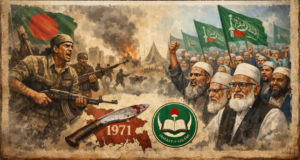
The 12th February 2026 general election in Bangladesh, culminating in a decisive victory for the Bangladesh Nationalist Party and a humiliating defeat for Bangladesh Jamaat-e-Islami, signifies more than an ordinary fluctuation in parliamentary arithmetic. It represents a reaffirmation of two intertwined judgements within the Bangladeshi Muslim consciousness; it was a historical verdict concerning 1971, and a religious instinct concerning authenticity. The electorate’s repudiation appears not episodic, but cumulative. Jamaat-e-Islami’s persistent marginalisation cannot be understood solely in terms of strategy or organisation. It is tethered, first and foremost, to the unresolved moral burden of the Liberation War. The events of 1971 were not a mere political rupture; they constituted the crucible through which Bangladesh emerged as a sovereign nation. Allegiances formed during that conflict were inscribed deeply into collective memory. For many Bangladeshi citizens, Jamaat’s association with that tragic chapter remains indelible. Democracy does not enforce amnesia. Nations forged in sacrifice do not easily detach political actors from the roles they are believed to have played in moments of existential peril. The electorate’s recurring rejection of Jamaat thus appears less a judgement upon its present manifesto than a refusal to absolve its past without unequivocal moral reckoning.
History alone does not exhaust the explanation. There exists a parallel anxiety of a theological nature. Islam, as understood by the overwhelming majority of Bangladeshi Muslims, is not an ideology devised in the twentieth century but the revival and restoration of primordial monotheism by Mohammed, the Selected One (peace be upon him). His mission, as articulated in the Qur’an, was a reminder calling humanity back to an uncorrupted path. The early Muslim community conceived of itself as a single ummah, united by devotion to God and fidelity to the Prophetic example. Over the centuries, however, intellectual schools and spiritual paths emerged. While these enriched Islamic civilisation, they also introduced layers of interpretation that sometimes hardened into factional identities. In the modern period, movements such as Deobandi, Salafi, Islamist, Jamati, Ahmadi, and others arose within distinct historical contexts, each claiming fidelity to Islam, yet each imprinting upon it a particular inflection.
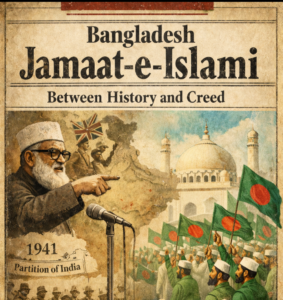
Jamaat-e-Islami, founded in 1941 by Syed Abul A‘la Mawdudi, represented not merely a theological school but an explicitly ideological project. Mawdudi reframed Islam in the jargon of modern political theory, presenting it as a comprehensive system to be realised through disciplined party organisation and the pursuit of an Islamic state. Sovereignty, he argued, belongs to God and must be realised through structured political struggle. It is precisely this ideological reframing that has invited suspicion among many traditional Muslims in Bangladesh. For them, Islam is primarily an inherited faith embodied in ritual devotion, communal continuity, and moral refinement, rather than a party programme. When religion is articulated predominantly as an “ism”, attached to manifestos and cadres, it risks appearing as a sectarian construction rather than the universal creed of the ummah.
This perception is reinforced by certain ritual divergences. For example, it is widely observed that many adherents of Jamaat do not engage in audible supplication after the five daily prayers, maintaining that the prescribed prayers themselves suffice as supplication. While juristic debate over such matters is neither new nor illegitimate within Islamic scholarship, popular religious culture in Bangladesh accords significance to collective du‘a after prayer. To abstain from it is, in the eyes of many worshippers, not a mere technical preference but a departure from cherished communal practice. Thus, Jamaat becomes associated not only with political controversy but with religious heresy perceived as alien to mainstream devotional life. In a society where Islam is lived through shared rituals, shrine visits, commemorations, and collective invocations, any movement that appears to narrow or rationalise these practices may be regarded as estranged from the spiritual temperament of the majority.
It must also be observed that Jamaat is by no means the only political formation in Bangladesh to claim Islamic credentials. Indeed, there exist scores – arguably hundreds – of parties and factions that present themselves as guardians or implementers of Islam in public life. Nonetheless, none of these organisations has ever secured sufficient public confidence to form a government independently. Their trajectories have been marked less by consolidation than by fragmentation. Competing claims to religious authenticity have often produced rivalry rather than unity; movements that profess to defend Islam frequently contest, denounce, and invalidate one another in public discourse. The result is a proliferation of banners under which Islam is invoked, but rarely a unified political mandate from the electorate.
When this theological multiplicity converges with the unresolved trauma of 1971, the result is profound mistrust. Mainstream Muslims who revere both their faith and their national history find little incentive to endorse a party viewed simultaneously as politically compromised and religiously ambiguous. The charge, whether fair or exaggerated, is that Jamaat represents not the broad river of Sunni Islam as practised in Bangladesh, but a narrower current shaped by twentieth-century ideological ambition. From this vantage point, Jamaat resembles one of the many modern “isms” that crystallised around a founder, a manifesto, or a distinctive interpretive lens. The multiplication of such identities – Deobandi, Salafi, Islamist, Jamati, Ahmadi, and many more – has, for some observers, obscured the prophetic simplicity of Islam that require devotion to one God, adherence to the Sunnah, moral rectitude, and communal solidarity. When secondary formulations become primary markers of allegiance, unity recedes.
The electorate’s verdict may therefore be read as both political and cultural. It suggests that Bangladeshi Muslims, while diverse in practice, remain instinctively wary of movements that appear to subordinate inherited tradition to ideological system-building. They appear equally unwilling to detach political participation from moral accountability for national tragedy. Jamaat’s debacle at the polls should in itself be sufficient to induce sobriety. Rather than boasting of past organisational prowess or its reputed capacity to mobilise cadres, Jamaat would be better served by questioning its own moral foundations and turning inward in earnest introspection. A politics of self-examination, rather than self-congratulation, may open the possibility of realistic change. Without such interior reckoning, public rhetoric about strength and resilience will ring hollow against the arithmetic of electoral defeat.
The sooner the Jamati recognise that elements of their political ideology and religious posture are perceived as flawed within the broader Muslim community, the greater the possibility of meaningful recalibration. Delay only entrenches marginality. Early acknowledgement would afford them the time and space necessary for substantive transformation, including reconsideration of their name, their institutional identity, and their overt intellectual tethering to Mawdudi. It would also permit a more candid reckoning with the events that unfolded in 1971, without which public trust is unlikely to be restored.
Is renewal possible? The metaphor of the phoenix remains apt. Cosmetic adjustment will not suffice. If Jamaat-e-Islami seeks a viable future, it must confront both dimensions of its predicament. Politically, this requires unambiguous moral reckoning with 1971. Religiously, it would require a demonstrable reintegration into the mainstream devotional ethos of the Bangladeshi Muslim, affirming not merely abstract sovereignty of God but the lived practices cherished by the faithful. Whether such a transformation entails dissolution and reconstitution under a different banner is a matter for its leadership. What seems clear is that without a profound reset, electoral marginality will persist. The Bangladeshi voter has shown continuity of judgement; memory and piety alike shape political choice.
In the final analysis, the rejection of Jamaat-e-Islami reflects a deeper principle. Islam, in its prophetic articulation, was a unifying call. National history, in Bangladesh, was forged through sacrifice. Any movement perceived to stand apart from either unity or sacrifice will struggle to command allegiance. Nations remember, and believers discern.