Bangladesh Independence Day Celebrations and the Road Ahead

Imran Chowdhury BEM
Bangladesh Independence Day is not merely a national celebration; it is a day of remembrance, gratitude, dignity, and renewed purpose. Every year on 26 March, the people of Bangladesh honour the courage, blood, tears, and sacrifices that made the country’s freedom possible. It is a day when the red and green flag rises not only over buildings and institutions, but also in the hearts of millions who remember that this freedom was earned at a terrible human cost.
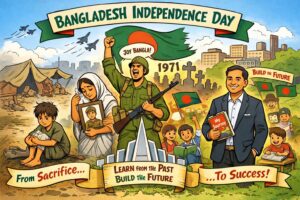
For some, Independence Day is a public event of parades, wreaths, songs, speeches, and school programmes. For others, it is deeply personal. For me, it is both. I look at Bangladesh not only as a citizen who loves his country, but also through the journey of my own life: from a destitute refugee young boy to a member of a family marked by sacrifice, the son of a valiant freedom fighter, and today, a social entrepreneur committed to serving people and building communities.
My life has been shaped by the unfinished echoes of 1971. I come from a family that knew struggle, danger, loss, and displacement. I know what it means to be uprooted by war and to survive as a refugee. I know what it means to grow up in the shadow of sacrifice. My late father’s bravery in the Liberation War, and the wider suffering of countless families like ours, taught me that independence is never abstract. It is paid for by real people, real wounds, and real acts of courage.
That is why Independence Day must be celebrated with pride, but also with humility. We must celebrate not only the victory itself, but the values that made victory meaningful: resilience, unity, justice, secular spirit, human dignity, and love for the motherland. Bangladesh was born through sacrifice, but it was also born through hope. That hope still matters.
The road ahead for Bangladesh must therefore be guided by the lessons of the past. Future generations should learn that freedom is not self-sustaining. A country can be politically independent, yet morally weakened if it forgets its history, neglects its people, or allows division, intolerance, corruption, and indifference to grow. The younger generation must understand that their ancestors did not suffer simply so that Bangladesh could exist on a map; they suffered so that it could stand as a just, confident, compassionate, and self-respecting nation.
This learning must begin in homes, schools, books, community institutions, and public discourse. Children should be taught the human stories of 1971, not merely dates and slogans. They should know about the refugees, the freedom fighters, the mothers who waited, the martyrs who never returned, and the ordinary villagers and families who carried extraordinary burdens. History should be made alive, moral, and meaningful.
At the same time, the best way to honour the Liberation War is to build the Bangladesh that the martyrs dreamed of. That means investing in education, truth, civic ethics, cultural confidence, social justice, and opportunity for all. It means creating a country where young people do not inherit despair, but responsibility and hope. It means ensuring that patriotism is expressed not only in ceremonies, but in honest work, public service, and care for one another.
My own journey from hardship to community leadership has strengthened my belief that sacrifice should inspire service. If a refugee child from a wounded time can grow into someone trying to serve society, then that itself is a testament to the strength of Bangladesh’s founding spirit. Independence Day should remind us that the nation’s greatest tribute to its heroes is not only memory, but action.
Bangladesh has travelled far. Its future can be brighter still. But only if its next generations walk forward with history in their hearts, gratitude in their conscience, and duty in their hands.
Selected Bibliography
Chowdhury, Imran. Bangladesher Shadhinota Juddho o Gonohottar Itihas.
Chowdhury, Imran. Surviving Bangladesh Genocide & Liberation War, 1971: A Tween’s Journey.
Chowdhury, Imran. বাংলাদেশ স্বাধীনতা যুদ্ধে ই পি আর – ১৯৭১ সালে ই পি আর এর বীরগাথা.
Ahmed, Jahanara. Ekattorer Dinguli.
Islam, Major Rafiqul. A Tale of Millions.
Mascarenhas, Anthony. The Rape of Bangladesh.
Government of Bangladesh. Bangladesh Documents on the Liberation War