The Moral Limits of Election Campaigns and the Intelligence of the Electorate in Bangladesh
By K S T Qureshi
As Bangladesh approaches its forthcoming general elections on 12 February 2026, Jamaat-e-Islami once again finds itself confronted by a familiar and serious accusation that it employs religious guile to influence voters, allegedly by implying that political support for the party carries spiritual reward, crudely caricatured as the sale of “tickets to heaven”. While the phrase itself is polemical, the allegation it gestures towards raises questions of genuine democratic and ethical significance. At stake is not merely the conduct of one party, but the broader issue of how faith may, or may not, be legitimately mobilised in electoral politics. The controversy also invites a deeper inquiry into the nature of the electorate. Are Bangladeshi voters truly so gullible that they would conflate a ballot cast in this world with salvation in the next, despite a widely shared Islamic understanding that the Day of Judgement rests upon individual faith, moral intention, and righteous deeds. Or does the accusation itself betray a condescending misreading of popular religious consciousness.
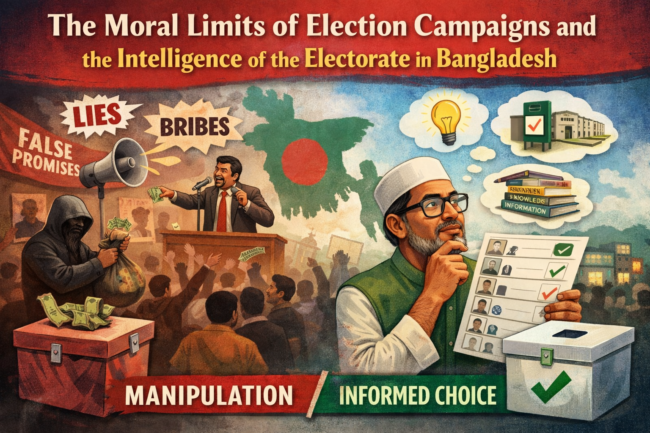
Critics of Jamaat-e-Islami argue that the party habitually operates in a grey zone between moral exhortation and political inducement. The charge is not that Jamaat makes a literal theological claim that paradise can be purchased through votes, but that its rhetoric often implies a moral hierarchy of political choices, wherein support for the party is subtly framed as a religious duty and opposition as moral deviation. If such an allegation is substantiated, the implications are grave. To suggest, even implicitly, that divine favour is contingent upon partisan allegiance would amount to a manipulation of voters through a distorted understanding of religion itself. Islam, in its mainstream theological tradition, does not authorise any political organisation to act as a broker of salvation. Should Jamaat be found guilty of fostering such impressions, it would not merely be guilty of political opportunism, but of instrumentalizing religious ignorance, reducing complex doctrines of accountability and divine justice to campaign slogans.
Such conduct, if proven, would warrant more than moral censure. It would justify concrete amendments to election campaign rules, specifically to prohibit any form of messaging that implies spiritual reward or punishment as a consequence of electoral choice. Democratic competition presupposes free consent. Spiritual intimidation, however subtle, corrodes that freedom at its root. This critique is sharpened by history. Jamaat’s contested role during the Liberation War of 1971 continues to inform public suspicion, particularly among constituencies committed to the secular and plural foundations of the republic. Against this backdrop, any attempt to sacralise contemporary political authority appears to many as an effort to bypass historical accountability by retreating into moral absolutism.
Jamaat’s defenders, however, contend that such accusations rest on a deeply patronising assumption that Bangladeshi Muslims lack the theological literacy to distinguish between religious ethics and eschatological certainty. This, they argue, is demonstrably false. The belief that entry into paradise depends on faith, conduct, and divine mercy is neither obscure nor elite knowledge. It is part of the religious common sense of the society. From this standpoint, the charge of “selling heaven” is seen as a rhetorical weapon rather than an empirical claim. Jamaat, its supporters insist, merely articulates a moral vision of governance grounded in Islamic values, honesty, social justice, restraint, and accountability. Voters who respond to this language are not purchasing salvation. They are endorsing a normative framework they already hold to be meaningful.
Moreover, Jamaat argues that moral discourse in politics is not inherently illegitimate. All ideological parties appeal to values that transcend immediate material interest. To single out religious language as uniquely manipulative, while accepting secular moral appeals as neutral, is itself a form of ideological bias.
In juxtaposition, Bangladesh Nationalist Party (“BNP”) occupies an uneasy middle ground in this debate. Publicly, BNP tends to criticise overt religious manipulation, positioning itself as a nationalist and pragmatic force rather than a doctrinal one. This allows it to present itself as respectful of voters’ intelligence, drawing a nominal boundary between faith and formal politics. However, BNP’s record complicates this posture. Its historical alliances with Jamaat reveal a willingness to benefit from religious mobilisation when electorally expedient. If Jamaat’s methods are indeed unethical, BNP’s collaboration appears morally compromised. If, on the other hand, those methods are legitimate expressions of political ideology, BNP’s selective outrage appears opportunistic. In this sense, BNP’s ambiguity reflects a broader malaise, namely the absence of a principled consensus on the permissible role of religion in democratic contestation.
Underlying the entire controversy is a persistent misrecognition of popular agency. Bangladeshi voters are neither passive nor doctrinally confused, and surely they are not as gullible as they have been portrayed. Their electoral decisions are shaped by a dense interplay of material conditions, historical memory, local networks, moral identity, and strategic calculation. Religion is one element within this matrix, not a substitute for judgement. To attribute electoral outcomes to mass credulity is intellectually evasive. It absolves political actors of responsibility for governance failures and reduces complex social behaviour to caricature. More importantly, it obscures the real issue, whether political elites are respecting or abusing the moral resources of society.
The allegation that Jamaat-e-Islami trades in promises of heavenly reward should not be dismissed lightly, nor accepted uncritically. If proven, such conduct would constitute a serious form of voter manipulation, grounded in a misrepresentation of religious doctrine, and would rightly demand regulatory intervention in campaign practices. If unproven, the accusation risks functioning as a convenient slur that infantilizes the electorate and forecloses substantive debate. What Bangladesh requires is neither sanctified politics nor cynical secularism, but clear ethical boundaries. Jamaat must be held accountable for any attempt to conflate divine judgement with electoral loyalty. BNP must confront its own instrumental alliances and moral inconsistencies. Above all, democratic discourse must proceed on the recognition that voters are capable of distinguishing between faith, politics, and the ultimate reckoning of conscience.