Ceasefire
By K S T Qureshi
History offers many lessons about the limits of power, but political regimes often learn them only through painful experience. In moments of military confrontation with vastly stronger adversaries, wisdom lies not in rhetorical defiance but in sober calculation. At such moments two simple phrases in the English language capture a strategic truth that seasoned statesmen understand, “if you cannot beat them, join them” and “damage limitation”. Although these phrases may sound colloquial, they reflect an enduring principle of political realism. For the hardliners within Iran and Israel, these principles are no longer optional intellectual exercises, they have become an urgent necessity. War has a cruel logic. Once initiated, it rarely proceeds according to the plans of those who begin it. Leaders may imagine limited escalation, manageable retaliation or symbolic demonstrations of strength. Reality, however, tends to be harsher. When the balance of power is dramatically unequal, miscalculation becomes catastrophic. The strategic environment confronting Iran today illustrates precisely such a dilemma.
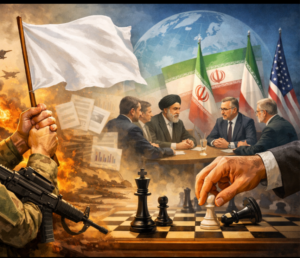
For decades, the Iranian political establishment has cultivated an image of resistance against global powers, particularly the United States and its allies. That posture has been woven into the ideological identity of the state since the Iranian Revolution, but ideological posture cannot substitute for military parity. Although a revolutionary narrative may inspire domestic loyalty, it cannot neutralise the immense technological, economic, and logistical advantages possessed by a global superpower. The current confrontation has already exposed a troubling fact that the Iranian leadership appears to have underestimated the scale of the response that such tensions could provoke. The damage inflicted thus far – whether strategic, economic, or reputational – was clearly not anticipated by the regime’s decision-makers. This failure of anticipation is itself revealing. If the leadership was unable to assess the consequences of the initial escalation, it is difficult to believe that it can accurately calculate the far greater destruction that would follow a prolonged conflict.
Military strategy requires brutal honesty about one’s own capabilities. Nations that misjudge their strength often stumble into conflicts that devastate their societies. From a purely rational standpoint, the leadership in Iran must confront a simple question: can it realistically prevail in a prolonged confrontation with a superpower-backed coalition? If the answer is no – and all available evidence suggests that it is – then continuing down the path of escalation becomes an act not of courage but of political self-harm. This is where the principle of damage limitation becomes indispensable. Damage limitation does not mean surrendering national dignity. It does not require abandoning sovereignty or strategic interests. Rather, it reflects the pragmatic recognition that the first duty of any government is to preserve the state and protect its citizens from unnecessary catastrophe. In this sense, advocating a ceasefire is not an act of weakness but an act of statesmanship. A ceasefire would halt the immediate cycle of retaliation and create space for diplomacy, negotiation, and recalibration. It would prevent further destruction of infrastructure, avert additional economic collapse, and most importantly spare ordinary civilians from the horrors that accompany prolonged warfare.
War, by its nature, brings devastation; however, history demonstrates that the aftermath of war can also open a new chapter of reconstruction. The period following conflict often creates unexpected opportunities for national renewal. Reconstruction requires political will, disciplined leadership, and a willingness to learn from the past. In certain cases, nations that suffered enormous destruction have later transformed themselves into models of economic dynamism. A striking example is Japan after World War II. Emerging from the war with shattered cities, a collapsed industrial base, and a humiliated political system, Japan appeared to many observers to be permanently weakened.
Contrary to this popular belief, through careful economic planning, institutional reform, and integration into the global economy, Japan rebuilt itself with remarkable speed. Within a few decades it had risen from wartime devastation to become one of the most admired economies in the world.
Such transformations remind us that destruction does not necessarily define a nation’s destiny. The decisive factor is how political leadership responds once the reality of war becomes undeniable. If leaders cling stubbornly to confrontation, devastation deepens. If they pivot toward reconstruction and reform, the same crisis can become the starting point of renewal. The people of Iran – workers, students, merchants, and professionals – stand to lose far more from continued escalation than any political faction stands to gain. Cities may be damaged, economic hardship may deepen, and a generation’s prospects could be permanently scarred. Yet if the present leadership recognises the limits of its strategic position and chooses to end the war before further destruction occurs, the country could eventually redirect its energies toward rebuilding its economy and strengthening its institutions. Moreover, a regime that refuses to soften its approach risks punishing itself as much as its adversaries. Persistent confrontation with a vastly stronger opponent does not strengthen a government’s legitimacy; it erodes. People eventually ask whether ideological rigidity is worth the price of national devastation.
Ceasefire, therefore, should be viewed as the beginning of strategic reassessment rather than an admission of defeat. By halting the conflict, Iranian leaders could regain diplomatic initiative. They could engage regional actors, explore confidence-building measures, and gradually rebuild the political space necessary for stability. Such a shift would also signal to the international community that pragmatism has begun to replace conflict. For such a ceasefire to be credible and sustainable, it must be negotiated through a neutral and internationally recognised platform. The most appropriate institution for this task is the United Nations. Among global institutions, the United Nations remains uniquely positioned to facilitate dialogue among adversaries. Its diplomatic channels extend to nearly every state involved in or affected by international conflicts. As a forum where competing powers can communicate without direct confrontation, it possesses the institutional legitimacy and global reach necessary to broker a ceasefire. By placing negotiations under the auspices of the United Nations, all parties could be brought to the table in a structured and internationally monitored process. Such mediation would help ensure transparency, reduce mistrust among the combatants, and provide a mechanism for verifying compliance with ceasefire commitments. It would also reassure smaller regional actors whose security may be indirectly affected by the continuation of the conflict.
In many historical cases, governments that initially adopted uncompromising rhetoric later recognised the necessity of negotiation. What distinguished successful leaders from disastrous ones was their ability to adjust course before irreparable damage occurred. Strategic flexibility, after all, is not cowardice; it is wisdom. The alternative path is far conducive to national reconstruction. If the war continues, the scale of destruction will almost certainly exceed anything experienced so far. Military infrastructure, economic networks, and social cohesion could all suffer irreversible damage. What began as a limited confrontation could escalate into a national calamity! For this reason, the hardliners would do well to reflect on those two deceptively simple English phrases. If you cannot beat them, join them, and when circumstances become dangerously unfavourable, practise damage limitation. Both expressions point toward the same conclusion. A ceasefire is now the most rational course available.
By embracing restraint rather than escalation and by allowing the United Nations to mediate a negotiated ceasefire, Iranian leaders could protect their nation from further suffering and preserve the possibility of a more stable future. The purpose of politics is not endless confrontation but the safeguarding of the state and its people. In the present moment, the path of ceasefire represents precisely that responsibility.