

The Origin of Jagannathpur
K S T Qureshi
In the watery heartland of what is now northeastern Bangladesh, the geography of settlement has always been inseparable from the slow choreography of silt and season. By the close of the fifteenth century and into the sixteenth, an islet is believed to have risen from the midst of an expansive water body, which some historians consider to have been the remnant of an ancient sea. Over generations, annual alluvial deposits gradually elevated the seabed. What emerged was not firm upland but a distinctive ecological formation, the haor (also rendered hawar), a bowl-shaped wetland that transforms dramatically with the monsoon cycle.
Upon this newly raised ground, a small but culturally significant development took place. A group of Hindu wandering mendicants, popularly known as Vaishnavs, selected the islet as the site of an annual day-long religious and commercial gathering. The event came to be known locally as ban’ni (“banyi”), a term that in its modern sense approximates banijya mela, a trade fair. In these early assemblies, commerce and devotion were not opposites but companions; exchange of goods coincided with the exchange of stories, songs, and ritual observance.
Over time, the banyi expanded in ritual elaboration. The pulling of the rath, the ceremonial chariot – juggernaut – associated with Jagannath, was incorporated into the festivities. This addition aligned the local fair with the broader Vaishnava tradition of Rath Yatra, a festival widely observed across eastern India and Bengal. Thereafter, the annual gathering came to be known interchangeably as banyi or rath, the latter serving as shorthand for rath’r mela. The dual naming reflected the syncretic character of the event, simultaneously a devotional procession and a seasonal marketplace.
The principal organiser of the banyi and rath established his homestead on the very ground where the festivities were held. That residence came to be known as banyi barhi. Though ownership has changed hands over the centuries, the site itself endures in local memory and geography. The homestead functioned not merely as a private dwelling but as a nucleus of community life, anchoring what would gradually become a settled habitation.
As is often the case in deltaic Bengal, settlement followed ritual. Other households emerged around banyi barhi, first tentatively and then with increasing permanence. The once-isolated islet evolved into a village, its identity shaped by the annual rhythm of fair and festival. The settlement was named after the deity whose chariot procession had become its defining spectacle, Jagannath. Thus arose Jagannathpur.
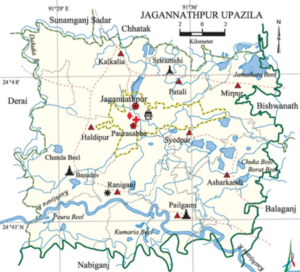
Today, Jagannathpur is not only a village but also a municipality and an upazila (subdistrict) within Sunamganj, itself part of the Sylhet region of Bangladesh. Its contemporary administrative status stands in contrast to its modest origins as a silt-born islet animated by wandering ascetics and seasonal traders. Beneath its present civic form lies the layered memory of water, worship, and commerce.
The historical narrative of Jagannathpur, however, has not been free from embellishment. At one point, a figure named Taranath Choudhury of nearby Kuwazpur composed a ballad asserting that Jagannathpur had once been the seat of a kingdom and that he himself was heir to its wealth. Poetry here was not mere literary exercise; it became an instrument of legal ambition. On the basis of his own composition, Taranath filed a claim seeking recovery of land both in his own village and in Jagannathpur, invoking the alleged royal past as justification.
Subsequent inquiry revealed the claim to be an elaborate fabrication. Taranath, together with an accomplice, Madanmohan Chaudury of Kuwazpur, had constructed the narrative of a lost kingdom in order to press their case against the government. Crucially, Taranath’s description of the royal family of his supposed Jagannathpur kingdom was found to be virtually identical to the well-documented description of the royal family of Tripura. This striking duplication exposed the derivative nature of his claims and became one of the principal reasons he was caught red-handed. Their attempt ultimately failed, as they were unable to furnish credible evidence for the existence of such a polity in Jagannathpur. The supposed kingdom dissolved under scrutiny, exposed as invention rather than inheritance.
Nevertheless, the episode illustrates a subtle truth about local historiography: repetition can confer plausibility. Despite the legal failure of the claim, some inhabitants continue to believe that a kingdom once flourished there, sustained by the lingering aura of Taranath’s ballad and the power of oral circulation. In regions where written archives are sparse and memory travels through verse, the boundary between folklore and fact can become porous.
Jagannathpur’s story therefore unfolds along two intertwined trajectories. The first is ecological and devotional, an islet born of silt, consecrated by Vaishnav mendicants, and consolidated through the annual banyi and rath festival dedicated to Jagannath. The second is narrative and contested, a ballad-based claim to royal antiquity that sought to transform imagination into property rights.
Between these strands lies a broader reflection on how places acquire meaning. Geography provides the stage, ritual gathers the community, and storytelling, whether faithful or fanciful, seeks to deepen the past. Jagannathpur’s origins rest not in royal courts but in seasonal fairs and chariot processions. Nevertheless, the persistence of the kingdom myth demonstrates the enduring human impulse to dignify one’s homeland with grandeur.
In the end, the historical weight of Jagannathpur does not depend upon the existence of a fictional throne. Its significance resides instead in the steady accumulation of silt and settlement, in the devotion of wandering ascetics, and in the communal energy of an annual mela that transformed a watery rise into a named and enduring habitation.