

The Parliament Must Speak to the Nation’s Real Suffering!
K S T Qureshi
Parliamentary democracy derives its strength not merely from constitutional procedure, but from its responsiveness to the anxieties and hardships of ordinary citizens. In Bangladesh, however, parliamentary debates have too often resembles a stylus trapped upon a scratched gramophone record; endlessly repeating the same constitutional questions, referendum disputes, and procedural arguments, whilst the urgent realities of national life remain inadequately addressed.
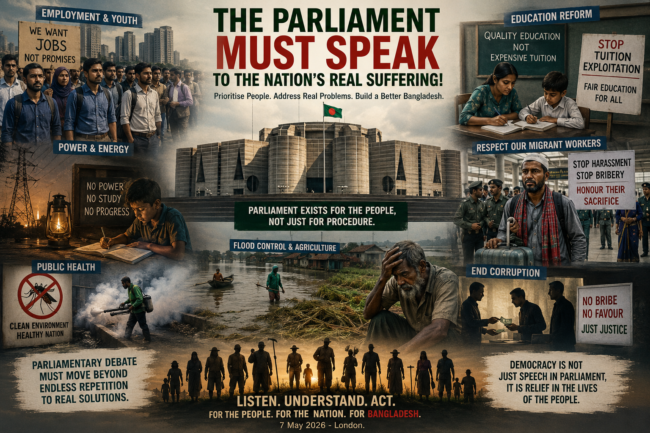
There can be little doubt that constitutional matters are important. The Constitution is the backbone of the Republic, and any undertaking given through referendum carries political and moral significance. Such questions deserve serious consideration. Nevertheless, mature parliamentary culture demands balance, discipline, and perspective. When Members of Parliament repeat the same arguments ad infinitum, without advancing meaningful solutions to contemporary problems, the institution itself begins to appear detached from the lived experiences of the people.
Bangladesh today faces a multitude of pressing crises that deserve far greater parliamentary attention than they currently receive. The nation’s elected representatives are not novice agitators upon a street corner; they are seasoned politicians entrusted with the responsibility of governance. Their duty is not to beat around the bush with repetitive rhetoric, but to identify national priorities and move forward with the times.
Foremost amongst these concerns is the issue of employment and unemployment. Every year, thousands of graduates emerge from universities and colleges with hopes of respectable careers, only to encounter shrinking opportunities and widespread frustration. In both urban centres and rural districts, young people increasingly feel disconnected from the economic future of the nation. Parliamentary debate ought therefore to focus upon industrial expansion, vocational training, foreign investment, agricultural modernisation, and entrepreneurship rather than remaining trapped within circular constitutional discourse.
Equally troubling is the continuing crisis of electricity and load shedding. Despite improvements over the years, many regions still suffer from irregular power supply, particularly during periods of extreme weather. Small businesses, students, hospitals, and ordinary households all endure the consequences. In a modern economy, reliable electricity is not a luxury; it is the foundation of productivity and development. Parliament must therefore devote sustained attention towards energy diversification, infrastructure maintenance, renewable power generation, and accountability within the energy sector.
The condition of the education system also requires urgent scrutiny. Educational standards in many institutions have deteriorated alarmingly, whilst sections of the teaching profession have become associated with excessive private tuition practices. In numerous areas, students are indirectly compelled to seek private tutoring merely to succeed academically. This has produced an unregulated tuition industry that imposes severe financial burdens upon families, especially within rural Bangladesh where incomes remain fragile. Many parents now spend disproportionate portions of their earnings on private coaching simply because classroom teaching alone is perceived as insufficient.
Education, which ought to be an instrument of social mobility and national enlightenment, risks becoming commercialised and unequal. Parliament should therefore investigate curriculum quality, teacher accountability, fair remuneration, examination reforms, and regulatory mechanisms capable of protecting both students and parents from exploitation.
Another neglected issue concerns the treatment of migrant workers at airports and government checkpoints. Migrant labourers contribute billions in remittances that sustain the national economy, yet many returning workers report experiences of theft, harassment, extortion, and bribery. Such behaviour is not merely corrupt; it is profoundly insulting to citizens who sacrifice years of their lives abroad in difficult conditions for the welfare of their families and the prosperity of the nation. A civilised state must honour its migrant workers rather than subject them to humiliation upon their return home. Parliament must therefore insist upon stricter oversight at airports, transparent complaint mechanisms, surveillance systems, and exemplary punishment for officials engaged in bribery or theft.
Public health concerns equally deserve immediate parliamentary attention. Mosquito-borne diseases continue to threaten both urban and rural populations. Seasonal outbreaks of dengue and other illnesses reveal weaknesses in sanitation management, drainage systems, and municipal coordination. Mosquito eradication should not merely become a reactive campaign during outbreaks; it requires a sustained national strategy involving local government authorities, environmental planning, waste management, and public awareness initiatives.
Similarly, flood control remains essential for protecting agricultural harvests and safeguarding rural livelihoods. Bangladesh’s geographical realities make flooding inevitable to some degree, exacerbated by poor planning, weak embankment maintenance, river encroachment, and insufficient drainage infrastructure frequently transform natural challenges into humanitarian and economic disasters. When crops are destroyed, the effects ripple throughout the national economy, affecting food prices, rural employment, and social stability. Parliament should therefore prioritise long-term water management policies rather than temporary political arguments.
Perhaps the most corrosive issue affecting public confidence is the persistence of bribery across various government offices. From obtaining documents to accessing public services, ordinary citizens often encounter bureaucratic obstacles that encourage unofficial payments. Such corruption weakens trust in the state and disproportionately harms the poor, who possess neither influence nor financial flexibility. Parliamentary committees and ministers must treat anti-corruption reform not as a slogan, but as a national necessity tied directly to justice, economic efficiency, and social dignity.
Ultimately, Parliament must remember that democracy is judged not by the number of speeches delivered, but by the relevance and effectiveness of those speeches. Endless repetition of constitutional disputes may generate political theatre, yet it does little to relieve the burdens carried daily by farmers, labourers, teachers, students, shopkeepers, migrant workers, and struggling families across Bangladesh.
The nation does not expect perfection from its representatives. It expects seriousness, foresight, and practical engagement with reality. Parliamentary debate should therefore evolve from repetitive constitutional fixation towards a broader national agenda grounded in employment, infrastructure, education, agriculture, public health, anti-corruption measures, and the welfare of ordinary citizens.
If Parliament fails to speak to the people’s actual suffering, then its debates risk becoming little more than echoes within a decorated chamber. But if it confronts these pressing issues with sincerity and urgency, it may yet restore public confidence in democratic governance and reaffirm its role as the true voice of the nation.
7 May 2026 – London.