
Brexit Beckons
K S T Qureshi
Sir Keir Starmer’s apparent inclination towards closer alignment with the European Union may well prove to be one of the most consequential strategic miscalculations in modern British politics. While the Labour leader and now Prime Minister may view deeper cooperation with Brussels as economically rational and diplomatically prudent, such a posture risks alienating the very electorate whose trust he must preserve if Labour wishes to survive as a dominant governing force in Britain’s volatile political environment.
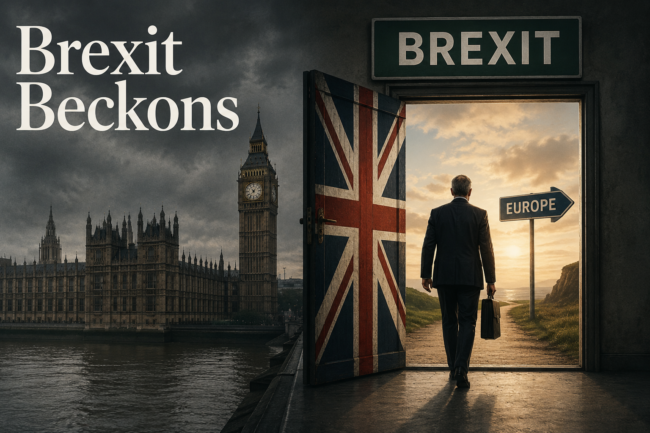
The political reality of post-Brexit Britain is far more profound than many Westminster strategists care to admit. Brexit was not merely a referendum on trade arrangements or customs regulations; it was an emotional, cultural, and democratic revolt by millions of voters who believed that sovereignty, national identity, and democratic accountability had been eroded by decades of supranational integration. Regardless of whether one supported or opposed Brexit, the referendum produced a decisive political independence. Any attempt to gradually reverse or dilute that decision risks reopening wounds that have not yet fully healed.
Sir Keir Starmer’s difficulty lies precisely here. Throughout much of his political career, he cultivated a distinctly pro-European image. During the Brexit years, he was closely associated with efforts to soften, delay, or effectively revisit Britain’s departure from the EU. Although he has publicly ruled out rejoining the single market or customs union, many voters remain sceptical. Politics, after all, is often governed less by manifestos than by perception. And the perception among substantial sections of the British electorate is that Labour’s leadership class remains emotionally and ideologically attached to Brussels.
This presents a dangerous contradiction for Labour. The party’s recent electoral gains depended heavily upon winning back working-class and lower-middle-class constituencies in England — particularly in former industrial regions that overwhelmingly voted Leave in 2016. These voters did not merely reject Conservative governments; they also rejected what they perceived as a detached metropolitan political establishment. They were weary of being lectured by technocrats, economists, and cultural elites who dismissed their anxieties as ignorance or nostalgia.
If Starmer now steers Labour towards overt European realignment, he risks confirming the suspicion that Brexit was never truly accepted by Britain’s governing class. Even modest proposals for regulatory convergence, judicial cooperation, or renewed institutional entanglements may be interpreted by many voters as the first steps towards re-entry through the back door. In politics, symbolism matters immensely. A government that appears psychologically incapable of embracing Britain’s post-EU independence will inevitably struggle to maintain credibility among Brexit-supporting voters.
The danger is not simply electoral arithmetic; it is existential political identity. Labour historically derived its strength from its ability to unite patriotic working-class voters with progressive urban constituencies. Yet these coalitions increasingly diverge on questions of nationhood, borders, sovereignty, and cultural identity. Starmer’s instinctive Europhilia may reassure liberal professionals in London, Manchester, or Bristol, but it risks deepening Labour’s disconnect from voters in Sunderland, Stoke, Doncaster, or Hartlepool — constituencies where Brexit remains not merely a policy preference but a statement of democratic self-respect.
Moreover, the broader European situation itself offers little political inspiration for British voters. Across the continent, the EU faces mounting internal tensions: sluggish economic growth, disputes over migration, democratic dissatisfaction, and the rise of nationalist parties in numerous member states. The romantic image of the European project that once captivated parts of Britain’s political class has faded considerably. Many British voters observe European politics today not with envy, but with caution.
Starmer must therefore recognise a fundamental truth about democratic legitimacy in Britain: the Brexit question has been settled politically, even if not emotionally for some sections of the elite. Attempting to gradually reorient Britain back towards European structures may satisfy segments of the commentariat, civil service, and internationalist intelligentsia, but it would come at enormous political cost. Voters who backed Brexit already harbour deep distrust towards political leaders whom they perceive as evasive or disingenuous. Any sign that Labour seeks to quietly dilute Britain’s independence could rapidly revive populist anger.
Indeed, the greatest beneficiary of such a development would not necessarily be the Conservative Party, but insurgent populist movements on the right. British politics has repeatedly demonstrated that whenever mainstream parties appear disconnected from public sentiment on sovereignty and immigration, alternative movements emerge to exploit the vacuum. UKIP transformed British politics once before; Reform UK and similar forces could do so again if Labour is perceived as reopening the European question.
For the survival of the Labour Party as a broad national coalition, Starmer may ultimately need to suppress his own pro-European instincts. Pragmatic cooperation with the EU on trade, security, and scientific research is unavoidable and sensible. Britain and Europe will always remain geographically and economically intertwined. Yet there is a profound difference between practical diplomacy and ideological gravitation. The former reflects statecraft; the latter risks political self-destruction.
A durable Labour government can only survive if it fully internalises the political meaning of Brexit. That does not require hostility towards Europe, nor does it demand nationalist theatrics. It simply requires accepting that a substantial portion of the British electorate no longer wishes to be governed through frameworks associated with Brussels. Respecting that sentiment is not reactionary; it is democratic realism.
Sir Keir Starmer’s challenge, therefore, is not merely administrative but philosophical. He must decide whether Labour intends to govern the Britain that exists, or the Britain many within its elite circles still nostalgically wish existed before 2016. If he continues to drift visibly towards the European Union, he may discover too late that electoral mandates in Britain are fragile, conditional, and easily withdrawn. The future survival of Labour may depend not on how closely it can align with Europe, but on how convincingly it can demonstrate that it has finally understood why Britain chose to leave in the first place.
20 May 2026 – London.