

Maulvi Abdul Karim and the Sylhati Nagri Script
K S T Qureshi
The history of the Sylhati Nagri script has, in recent decades, become a subject of considerable interest among certain sections of the Sylheti people. Enthusiasts frequently claim that manuscripts written in the Sylhati Nagri script date from as early as 1549 or, according to other accounts, 1774. Such claims are often repeated in books, articles, and online discussions as evidence that the script possesses a long and distinguished history stretching back several centuries.
However, a serious historical problem remains. The dates themselves are separated by more than two hundred years, revealing a striking lack of agreement among those advancing these assertions. More importantly, despite repeated references to these alleged manuscripts, the documents themselves have rarely been subjected to rigorous public scrutiny. Historians, linguists, and interested members of the public have not been presented with a clear body of evidence demonstrating the continuous existence of the script from the sixteenth or eighteenth century onwards.
In historical research, extraordinary claims require tangible evidence. Manuscripts must be available for examination, their provenance established, their age verified, and their contents analysed. Without such evidence, dates attached to purported manuscripts remain assertions rather than historical facts. The persistence of these claims nevertheless serves an emotional and cultural purpose. Many Sylhetis take pride in the idea that their region possessed a unique written tradition extending deep into the past. For some, particularly those who feel culturally distinct from standard Bengali linguistic norms, the notion of a mediaeval Sylhati Nagri script offers a powerful source of identity and prestige.
However, cultural pride and historical evidence are not necessarily the same thing. A community’s sense of self-worth should not depend upon claims that cannot be substantiated. Indeed, there is a danger that uncritical acceptance of poorly evidenced historical narratives may encourage division rather than understanding. When an alleged mediaeval script is elevated beyond what the available evidence can support, it can foster the impression that Sylheti constitutes a completely separate linguistic civilisation detached from the broader Bengali cultural sphere.
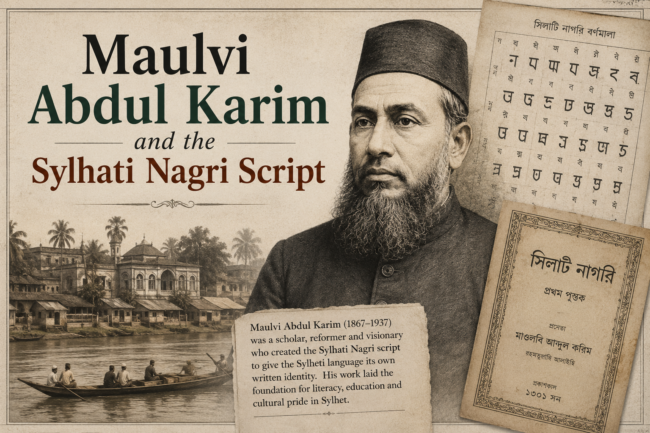
The documented history of Sylhati Nagri points in a different direction. Evidence suggests that a significant figure in the development of the script was a Sylheti scholar named Moulvi Abdul Karim. Around 1860, Abdul Karim travelled to Britain for higher education. During his stay, he reportedly learned the printing trade, acquiring technical knowledge that was becoming increasingly important in the age of mass literacy and print culture. Upon returning to Sylhet, Abdul Karim applied these skills to a local context. Around 1870, he established the Islamia Press in Sylhet Town and designed woodblock printing types for what became known as the Sylhati Nagri script. Subsequently, additional presses using the script appeared in Sunamganj, Shillong, and Calcutta. Through these presses, mythical literature, folk tales, stories, and popular works became accessible to ordinary people.
This development bears all the hallmarks of a nineteenth-century entrepreneurial venture. Abdul Karim identified a social need and sought to meet it through technological innovation. A sizeable rural population were unable to read or write standard literary Bengali, Urdu, Devanagari, Arabic, Farsi or English with ease or at all. A simplified writing system could therefore broaden access to printed material among readers with limited or no formal education.
Viewed from this perspective, Abdul Karim resembles what would today be called a startup founder. Rather than merely preserving an old tradition, he appears to have created a practical solution to a contemporary problem. By simplifying elements of the Devanagari writing system and reducing its complexity, he produced a script that was easier for ordinary people to learn and use. The comparison with modern entrepreneurship is striking. Successful innovators rarely invent entirely new concepts from nothing. Instead, they modify existing technologies, simplify complex systems, and adapt them to new markets. Abdul Karim’s work appears to fit this pattern precisely. His achievement lay not in preserving a forgotten relic from the distant past but in creating a functional and accessible tool for communication.
The subsequent spread of Sylhati Nagri literature reflects the success of this endeavour. Printing presses adopted the script, publications circulated among readers, and a modest literary culture emerged around it. Nevertheless, its flourishing remained largely tied to the printing networks established during the late nineteenth and early twentieth centuries. It is propagated by the early 1970s, the script had largely fallen out of everyday use. The spread of modern education, the increasing dominance of standard Bengali, and changes in printing technology contributed to its decline. Since then, Sylhati Nagri has survived primarily as a subject of academic interest among a handful of linguists, historians, and researchers studying the cultural history of northeastern Bangladeshi relic.
Furthermore, some scholars have drawn comparative observations that complicate the narrative further. According to Syed Murtaja Ali, Sylhati Nagri bears a resemblance to the Kaithi script, which was once used in a remote part of the historical Bihar region. This comparison opens an additional line of inquiry, particularly given the well-established historical movement of people between Bihar and Sylhet. It is widely acknowledged that both Muslim and Hindu communities migrated from Bihar and settled in various parts of Sylhet over extended periods.
In this context, it becomes a legitimate question for historians to investigate the familial and migratory background of Moulvi Abdul Karim. If his forebears were indeed connected to Bihar, it may suggest that SylhatI Nagri was influenced, directly or indirectly, by writing traditions associated with the Kaithi script. Such a possibility would not diminish its nineteenth-century development but would instead place it within a broader South Asian continuum of script adaptation and modification from Devanagari.
This historical trajectory raises an important question. If convincing evidence for the script’s existence before the nineteenth century remains absent, should greater recognition not be given to Abdul Karim himself? Rather than attributing the script to an obscure and unverified mediaeval origin, it may be more accurate to acknowledge the individual whose documented activities transformed it into a functioning written medium. Such recognition would not diminish Sylheti heritage. On the contrary, it would celebrate a verifiable historical achievement. Abdul Karim’s accomplishment was significant precisely because it was modern, practical, and innovative. He identified a need, adapted existing writing traditions, developed printing technology, and created a literary marketplace for ordinary readers.
Historical myths may inspire pride, but documented achievements deserve even greater admiration. If the evidence ultimately demonstrates that Sylhati Nagri emerged as a nineteenth-century innovation rather than a mediaeval inheritance, then the script’s true story is not one of mediaeval origins but of creativity, entrepreneurship, and adaptation. In that case, Moulvi Abdul Karim should be remembered not merely as a printer or educator, but as the founder and architect of a distinctive writing system that briefly transformed the literary culture of Sylhet. Whether one agrees with this interpretation or not, the fundamental principle of historical inquiry remains unchanged. Claims require evidence, and evidence must be open to examination. Until verifiable manuscripts predating the nineteenth century are produced and subjected to scholarly scrutiny, the most firmly documented chapter in the history of the Sylhati Nagri script remains the work of Abdul Karim and the printing revolution he initiated in nineteenth-century Sylhet.