
For Britain’s Sake: We Must Ensure It Doesn’t Belong To Farage

Reform UK’s ‘surge’? Not so fast. Using MIT statistical methods employed by top-tier news outlets, we break down why these polls may be wildly misleading. The margin of error tells a very different story—and the real results start tonight. Don’t believe the hype.
_#UKLocalElections #ReformUK_
At 10 PM tonight, the voting stopped. But our work hasn’t.
Reform UK’s projected dominance in the West Midlands isn’t just a political shift—it’s a test of whether we’ve learned anything from history. But before we accept this narrative, we must examine the evidence critically.
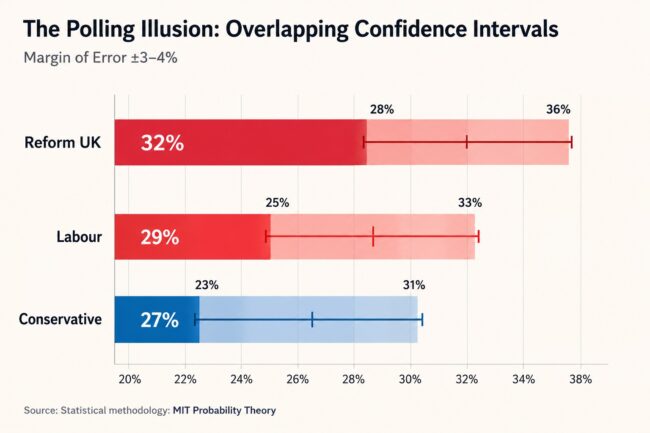
The polls predicting Reform’s surge deserve scrutiny. Most polls survey just 1,000-2,000 people to represent millions of voters. Even when done properly, they come with a margin of error of around ±3-4%. That means if a poll says Reform is at 32%, they could actually be anywhere between 28-36%. When the gaps between parties are small, these margins of error matter enormously.
Here’s a concrete example: if Reform polls at 32%, Labour at 29%, and Conservatives at 27%, those numbers overlap completely once you factor in the margin of error. What looks like “Reform dominance” is actually a statistical tie. The headlines hide this uncertainty.
Local elections are even harder to poll accurately. Unlike general elections, local races have:
Smaller sample sizes when broken down by area
Less historical data to build models on
Unpredictable turnout that’s hard to estimate
No track record for new parties like Reform UK
When pollsters try to predict individual council results, they’re taking already-uncertain national data and breaking it into smaller pieces. The errors multiply. It’s like zooming into a blurry photo—you don’t get more detail, just bigger pixels.
Voter preferences typically change gradually, not overnight. When we see dramatic polling swings, it often indicates problems with how the poll was conducted rather than a genuine revolution in voter thinking.
The results aren’t in yet, but our response must be ready—and it must be grounded in reality, not polling hysteria.
If Reform UK makes gains—whether they match the polls or not—the real battle begins tomorrow. Local councils control housing, schools, social services, and community cohesion. These aren’t abstract political prizes. They’re the institutions that shape our daily lives, our children’s futures, and the character of our communities.
We cannot let them normalize their politics in our towns and cities.
Results will trickle in over the next 72 hours. We need to be organized, united, and vocal. This isn’t about Labour vs Conservative, or Leave vs Remain anymore. This is about whether Britain belongs to all of us, or whether we hand the keys to Farage based on questionable polling that may not survive contact with actual ballot boxes.
The count begins now. Let’s wait for real data, not projections. And whatever those numbers show, our resistance begins immediately.