
From Stamford Hill to the shared moral teachings of Judaism and Islam, a story of religious conscience, charity and human dignity
The Other Jewish Story: Faith, Humanity and the Jews Who Reject Zionism

Walk through Stamford Hill in North London and you will encounter a Jewish community that many people know surprisingly little about.
There are families taking children to school, shopkeepers serving customers, elderly people making their way to synagogue and neighbours helping one another through life’s difficulties. Their traditional black clothing, distinctive customs and religious observances may attract attention, but their everyday concerns are familiar to people everywhere.
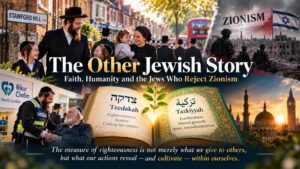
These are Orthodox Jewish Londoners whose lives are shaped by faith, family, education and community.
Yet there is something else worth understanding. Within this community are Jews who firmly reject Zionism.
They are deeply attached to Judaism and Jewish religious history, but do not believe that Jewish faith requires allegiance to the modern political movement that established Israel.
This distinction matters enormously in a world where Jews, Judaism, Zionism and the Israeli government are too often treated as though they mean the same thing.
They do not.
And perhaps the most interesting way to understand these religious communities is not through politics at all, but through their understanding of human responsibility.
A remarkable connection between Jewish and Islamic teachings
In Judaism, there is a beautiful principle called tzedakah.
Often translated as charity, its deeper meaning is righteousness and justice. Helping someone in need is not merely an act of kindness; it is a moral responsibility.
In Islam, sadaqah carries a closely related meaning. The Hebrew tzedakah and Arabic sadaqah even share related ancient Semitic linguistic roots.
The Qur’anic concept of tazkiyyah takes the discussion into a broader spiritual dimension.
In Surah At-Tawbah (9:103), charitable giving is connected with purification. The act of helping another person is also linked to the moral improvement of the giver.
This is the deeper dimension of tazkiyyah: not only giving away wealth, but also purifying the heart of greed, arrogance and selfishness.
It reaches inward towards character and upward towards spiritual responsibility before God.
Judaism, too, possesses wider traditions of spiritual refinement, including teshuvah, or repentance and return, and mussar, the cultivation of ethical character.
The two religions do not express these teachings identically. But their concerns overlap in a way that ordinary people, whatever their beliefs, can recognise.
Helping another human being matters. So does the intention, humility and moral character behind that help.
This shared concern offers a more human starting point for understanding Stamford Hill than the political divisions dominating today’s headlines.
The people behind the traditional clothing
Stamford Hill is home to one of Europe’s largest strictly Orthodox, or Charedi, Jewish communities.
Its modern history includes families who escaped persecution in Europe and rebuilt their lives in Britain.
Many preserve traditions of religious learning, family responsibility and organised charitable assistance.
The Jewish philosopher Maimonides, who lived in the twelfth century, described eight levels of charitable giving.
His highest level involved helping another person become financially independent, whether through work, partnership, a loan or other practical assistance.
That is a profound understanding of compassion. The objective is not simply to give someone money today but to help protect their dignity tomorrow.
In Stamford Hill, organisations such as North London Bikur Cholim provide practical assistance to people experiencing illness and hardship. Community welfare networks, housing organisations and volunteers help support families facing difficult circumstances.
Such work does not mean every individual or institution is beyond criticism. Like other communities, Stamford Hill faces social and economic challenges, including housing pressures and debates about education.
Nevertheless, its charitable traditions demonstrate how religious principles can become practical assistance.
Why some Orthodox Jews reject Zionism
Perhaps the greatest public misunderstanding concerns the relationship between Orthodox Judaism and Zionism.
Judaism is thousands of years old. Modern political Zionism emerged in the nineteenth century.
Zionism broadly advocates Jewish national self-determination in the historic Land of Palestine. Its supporters hold differing religious and political positions.
But some Orthodox Jewish traditions reject the idea that Jewish sovereignty should be established through human political initiative before the coming of the Messiah.
The Satmar Hasidic movement, represented in Stamford Hill, is among the best-known examples.
Satmar religious teaching distinguishes the Jewish people, the sacred Land of Israel and the modern Israeli state. Its opposition to Zionism arises from theological interpretations concerning exile, redemption and political authority.
This is not simply a disagreement with one Israeli prime minister or government policy. It is a longstanding religious objection to political Zionism itself.
In November 2021, rabbis associated with Stamford Hill’s Hatzola emergency medical organisation publicly disowned an Israeli ambassador’s visit. Their objection reflected the religious distance maintained by sections of the community from the Israeli state.
In December 2025, more than 2,000 strictly Orthodox Jews from Stamford Hill demonstrated outside the Israeli embassy in London against the conscription of Charedi Jews into Israel’s armed forces. Anti-Zionist arguments featured in material distributed at the protest.
These are concrete reminders that opposition to Zionism also exists within Jewish religious life.
However, Orthodox Jews do not all share this position. Some are Zionist, some non-Zionist and others explicitly anti-Zionist. A relatively small movement, Neturei Karta, is particularly visible at anti-Zionist demonstrations, but does not represent Orthodox Judaism as a whole.
The essential point remains: being Jewish does not automatically mean being Zionist, just as being critical of Zionism does not mean being hostile towards Jewish people.
Faith does not automatically confer political authority
Within certain anti-Zionist Orthodox traditions lies an especially interesting idea.
A people may have deep historical and religious attachment to a land without believing that this attachment authorises the establishment of political sovereignty through force.
For Satmar thinkers, the question is principally theological: who possesses the authority to bring about Jewish national restoration, and under what circumstances?
That argument is different from the modern legal questions surrounding Palestinian self-determination, military occupation, civilian protection and territorial rights.
Nevertheless, it demonstrates that religious reverence for a homeland and political nationalism are not necessarily the same thing.
This distinction is important for everyone involved in discussions of Israel and Palestine.
Jews must not be collectively blamed for actions undertaken by the Israeli government. Palestinians must not be denied their humanity because of political or military conflicts. Criticism of government policy should be judged on its substance rather than confused with hostility towards an entire people.
The same standard of human dignity should apply to all.
What we can learn from Stamford Hill
The Orthodox Jewish families of Stamford Hill are not merely participants in a distant geopolitical argument.
They are parents, children, teachers, workers, scholars and neighbours.
Some hold political beliefs that differ sharply from modern Zionism. Others do not. Their shared religious identity does not erase those differences.
Their traditions of tzedakah also reveal something that deserves wider appreciation: charity can be understood not as optional generosity, but as a duty rooted in justice.
The Qur’anic understanding of tazkiyyah adds another dimension to this discussion. Righteous conduct must be accompanied by attention to the condition of the human soul.
The wider Jewish traditions of teshuvah and mussar similarly recognise the importance of repentance and moral character.
Here lies a powerful area of common ground between Judaism and Islam, and indeed with people of other faiths or none.
We need not agree about theology or geopolitics to appreciate the dignity of helping someone in need, the importance of restraint or the value of examining our own conduct.
Before reducing Jewish people to Zionism, Muslim people to political movements, or any community to the actions of a state, we should remember that human beings are more than the ideologies attributed to them.
Stamford Hill offers a living reminder of that truth.
And the relationship between tzedakah and tazkiyyah leaves us with a simple but profound thought:
The measure of righteousness is not merely what we give to others, but what our actions reveal—and cultivate—within ourselves.
Selected references:
- The Jewish Chronicle, 8 November 2021 — Stamford Hill Rabbis Disown Ambassador’s Visit.
- Jewish News, 11 December 2025 — Over 2,000 Stamford Hill Orthodox Jews Protest Outside Israeli Embassy Against IDF Conscription.
- Satmar.org — How Satmar Understands Israel.
- Maimonides — Mishneh Torah, Gifts to the Poor, Chapter 10.
- The Qur’an — Surah At-Tawbah 9:103; Surah Ash-Shams 91:9–10.
- Martin Francisco Saps, Urban Studies (2026) — research on Stamford Hill’s Charedi community and urban change.