

Should Bangladesh Join the Makkah Pact? The Hidden Price of Collective Defence

15 October 2026 | Geopolitics · National Security · Political Economy
Bangladesh faces a consequential strategic question: should it join the Makkah Joint Defence Agreement between Saudi Arabia, Türkiye and Pakistan?
The prospect carries considerable attraction. Three influential Muslim-majority states, combining Saudi financial resources, Turkish defence technology and Pakistan’s military experience, have established a collective-security arrangement. For Bangladesh, an emerging economy modernising its armed forces while navigating a complex geopolitical environment, closer association could offer tangible advantages.

But a defence alliance is not simply an extension of diplomatic friendship. It changes the obligations, vulnerabilities and future choices of its members.
The central assessment is that Bangladesh should not commit to formal membership at present. It has strong reasons to deepen cooperation with all three countries, but the additional benefits of joining have not been demonstrated sufficiently to justify accepting potentially binding military obligations.
A pact already facing its first test
Signed in Makkah on 7 August 2026, the agreement establishes a collective-defence principle: an armed attack against one signatory is to be regarded as an attack against all.
The arrangement quickly moved beyond symbolism.
On 5 October, following attacks against Saudi Arabia, the alliance’s Strategic-Political and Defence Committee announced the practical implementation of collective-defence commitments, including arrangements for the rapid deployment of agreed military forces and capabilities under national legislation.
Türkiye subsequently explored defensive assistance, including air defence and electronic warfare, while explicitly excluding offensive participation. Its parliamentary ratification process was still pending.
These developments reveal a crucial distinction: political solidarity, treaty commitments and actual military participation are not identical.
For Bangladesh, which has no automatic obligation under the existing agreement, joining would raise difficult questions about the circumstances under which national forces, equipment, intelligence or financial resources might become committed to conflicts elsewhere.
The military opportunity—and its limits
The alliance’s combined capabilities are formidable.
Türkiye possesses an increasingly sophisticated defence-industrial ecosystem, including unmanned aircraft, electronic warfare, sensors and precision-guided systems. Pakistan offers extensive military experience, established defence cooperation and strategic expertise. Saudi Arabia contributes substantial defence expenditure, energy importance and diplomatic influence.
Bangladesh could benefit from joint training, intelligence exchange, military education, technology transfer, equipment maintenance and industrial partnerships.
These opportunities matter because Bangladesh must balance military modernisation against demanding fiscal priorities.
Yet an important distinction is frequently overlooked: access to Turkish defence technology or Saudi financing does not necessarily require Bangladesh to enter a collective-defence treaty.
Much could potentially be negotiated through bilateral procurement, industrial cooperation, training agreements and carefully defined security partnerships.
The relevant economic question is therefore not how valuable cooperation might be, but what additional, enforceable benefit formal alliance membership would deliver beyond those alternatives.
Unless that incremental benefit is established, attributing all potential military gains to treaty membership would exaggerate its value.
The economic exposure: protecting what Bangladesh already has
Bangladesh’s relationship with Saudi Arabia is economically significant.
Bangladesh Bank records show that Saudi Arabia supplied approximately $5.85 billion in workers’ remittances during FY2025–26, making it the country’s largest individual source. In July–August FY2026–27, Saudi-origin remittances reached approximately $1.146 billion, representing 19.7% of total inflows.
These are not abstract diplomatic statistics. Remittances support household consumption, foreign-exchange liquidity and national economic resilience.
Millions of livelihoods are connected directly or indirectly to overseas employment.
A major regional conflict could disrupt employment, migrant welfare, aviation, shipping and energy supplies. Higher energy and freight costs could also transmit pressure into Bangladeshi inflation, industrial production and the external accounts.
Critically, many of these vulnerabilities exist whether Bangladesh joins the pact or not.
Membership should therefore be judged by the additional exposure it creates, not blamed for the entire economic consequences of a Gulf crisis.
Closer Saudi cooperation might bring investment, employment opportunities or favourable financing. However, none of those benefits should be presumed to follow automatically from a military treaty.
Promises of investment and legally binding defence obligations are different categories of commitment.
One may remain aspirational while the other becomes operational during an emergency.
India’s response and Bangladesh’s strategic autonomy
The regional consequences deserve particular attention.
Bangladesh maintains extensive geographic, economic and security connections with India. Joining a formal military alliance that includes Pakistan would introduce a new consideration into Delhi’s assessment of Bangladesh’s strategic direction.
This would not necessarily produce a diplomatic rupture. India maintains relationships with Saudi Arabia and other Gulf states. Nevertheless, a collective-defence relationship involving Pakistan could complicate crisis diplomacy, military confidence-building and regional security calculations.
China adds another dimension.
Bangladesh already has significant defence relationships with Beijing, while Pakistan is closely connected to Chinese military supply chains. A new alliance could create opportunities for interoperability, but also introduce additional supplier dependencies and competing strategic expectations.
Bangladesh’s geographical position rewards flexibility. It benefits from maintaining workable relationships with India, China, the Gulf, Western partners and other Asian economies.
Formal military alignment can strengthen particular partnerships, but it may also narrow future choices.
That lost flexibility has strategic value even when it cannot be assigned a precise monetary price.
The overlooked risk: importing another country’s conflict
Collective defence allows states to share protection. It may also transmit threats across borders.
Saudi Arabia faces security challenges in the Arabian Peninsula and the wider Middle East. Türkiye operates within a complex environment involving NATO, Syria, Iraq and regional maritime disputes. Pakistan faces strategic pressures involving India and Afghanistan.
Bangladesh does not share all those threat environments.
An alliance could consequently expose Dhaka to military expectations arising from disputes in which it played no initiating role.
This is the problem of security coupling: a crisis affecting one member can trigger political or military decisions across the entire alliance.
The October developments demonstrate why this risk cannot be dismissed as merely theoretical.
Before contemplating membership, Bangladesh would need authoritative answers about treaty activation, overseas deployment, financial contributions, exceptions, withdrawal provisions and parliamentary oversight.
Would Bangladesh retain the right to refuse participation in offensive operations? Could it limit assistance to logistics, humanitarian protection or intelligence? Who determines whether an attack qualifies for collective defence?
Without clear answers, the future extent of national obligations remains uncertain.
The social cost of strategic decisions
Military alliances are negotiated by governments, but their consequences can extend throughout society.
Bangladeshi migrant workers could face evacuation or employment disruption during a regional emergency. Households could experience inflation arising from energy-price shocks. Taxpayers could bear new procurement or operational commitments.
Military personnel could face deployments beyond the country’s immediate strategic environment.
There are also questions of democratic legitimacy. Decisions involving foreign military obligations require transparent legal authority, public accountability and clearly defined institutional responsibility.
The security of the state and the welfare of its population must be evaluated together.
The decision Bangladesh actually faces
Three broad courses are available: formal membership, expanded cooperation without membership, or deferring a treaty decision pending further examination.
The important distinction is that these choices do not necessarily deliver the same benefits or impose the same obligations.
Bangladesh can pursue Saudi investment, Turkish defence-industrial partnerships, Pakistani military education and wider intelligence cooperation without automatically accepting collective-defence commitments.
Formal membership may offer further protection or strategic influence. But those additional advantages require verification against actual treaty terms, operational capabilities and credible economic commitments.
The strongest case for membership would demonstrate that it delivers protection Bangladesh cannot otherwise obtain, against threats Bangladesh actually faces, while preserving acceptable sovereign control over military participation.
The strongest case against it concerns contingent obligations, external conflict exposure, opportunity costs and reduced freedom of action.
On presently available evidence, the case for immediate accession remains insufficiently established.
Conclusion: cooperation without unnecessary commitment
Bangladesh does not need to choose between friendship with the Makkah Pact’s members and preservation of its strategic independence.
Its interests can support extensive economic, diplomatic and defence cooperation while leaving formal collective-defence membership subject to separate scrutiny.
The essential test is whether an alliance provides additional, enforceable security benefits sufficient to justify the obligations it creates.
Until that test is satisfied, there is a substantive distinction between strengthening relationships and committing national power.
For Bangladesh, the objective is not the greatest number of allies. It is the greatest dependable security and economic resilience consistent with sovereign freedom of action.
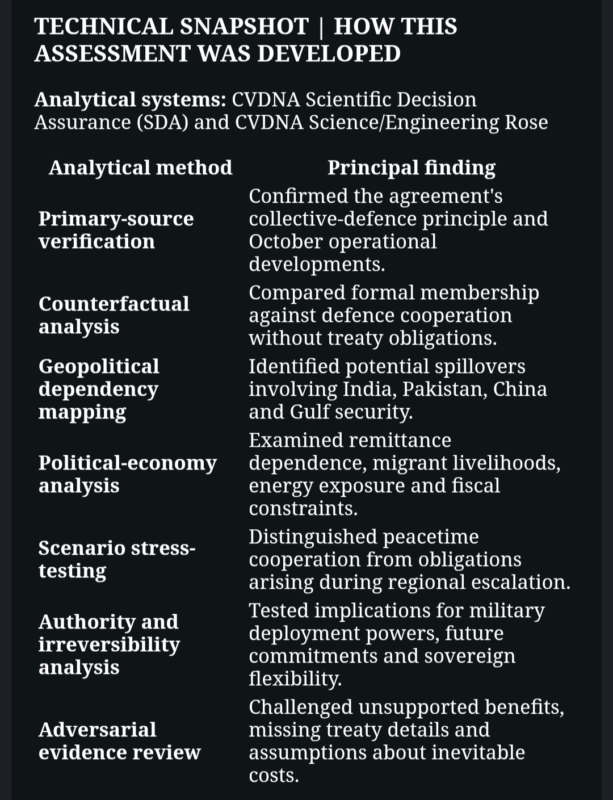
Assessment disposition: The evidence supports substantial cooperation opportunities but does not establish the incremental net benefit of immediate formal membership.
Evidence boundary: The analysis uses verified public information and conditional strategic reasoning. It is not a completed classified intelligence assessment, quantitative economic forecast or legal opinion on the full treaty text. No unsupported financial-loss estimates or conflict probabilities have been assigned.
Selected sources and verification
1. https://my.gov.sa/en/news/2835346
2. https://mofa.gov.pk/press-releases/joint-statementemergency-meeting-of-the-strategic-political-and-defense-committee-of-the-makkah-alliance-for-defense-riyadh-5-october-2026
3. https://www.reuters.com/world/asia-pacific/turkeys-foreign-minister-says-ankara-weighing-saudi-defence-support-rules-out-2026-10-08/
4. https://www.bb.org.bd/en/index.php/econdata/bop_remittance/1
5. https://www.bb.org.bd/en/index.php/econdata/bop_yearly/5
6. https://mofa.gov.pk/press-releases/strategic-political-and-defence-committee-of-the-makkah-agreement-for-joint-defence-joint-statement