
Could Bangladesh Reach the Moon for $75 Million – Less Than Dhaka’s Mosquito-Control Budget?

Could Bangladesh reach the Moon for less than $75 million?
For many Bangladeshis, the immediate answer would be no. Yet neighbouring India landed a robotic spacecraft on the Moon in August 2023 with a reported mission budget of approximately $75 million.
Here is the surprise. According to an investigation published by The Business Standard in June 2026, Dhaka’s two city corporations allocated more than Tk1,037 crore for mosquito control over ten financial years—equivalent to more than $80 million at recent exchange rates. That is more than the reported cost of India’s lunar mission.
NIS English 16-30 September, 2023+1
The comparison concerns budget allocations over a decade, not audited expenditure, and certainly does not suggest diverting money from dengue prevention.
But it raises an extraordinary scientific question: What would Bangladesh actually need to reach the Moon?
Bangladesh has already taken its first step
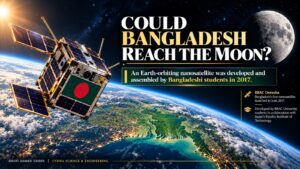
In 2017, three Bangladeshi students accomplished something remarkable.
Working at Japan’s Kyushu Institute of Technology, they designed, developed and assembled BRAC Onnesha, a nanosatellite measuring approximately ten centimetres along each side.
The spacecraft was transported to the International Space Station and deployed into Earth orbit on 7 July 2017. Its development demonstrated that Bangladeshi students could participate directly in spacecraft engineering—not merely study it in textbooks.
BRAC University+1
The achievement was modest in scale but important in principle.
Building a nanosatellite requires knowledge of electronics, software, communications, power management and the challenges of operating hardware in space.
Bangladesh also has experience operating a commercial communications satellite, launched in 2018, although the spacecraft was manufactured overseas.
The Bangladesh Space Research and Remote Sensing Organization (SPARRSO) works in satellite applications and remote sensing.
More recently, students at Ahsanullah University of Science and Technology have pursued indigenous nanosatellite engineering. Their reported work includes a locally developed onboard computer and experimental communications systems. These are development achievements, not yet evidence of an operational spacecraft in orbit.
The Daily Star
Together, these activities reveal a promising foundation—but not yet an integrated lunar programme.
Why reaching the Moon is so difficult
The Moon is approximately 384,400 kilometres from Earth. But distance alone is not the greatest obstacle.
A lunar spacecraft must follow a precisely calculated trajectory while travelling through a changing gravitational environment.
A small error in velocity can produce a substantial deviation over several days. Engineers must therefore continuously estimate the spacecraft’s position, calculate corrections and manage limited onboard fuel.
Communications present another hidden difficulty.
A ground station in Bangladesh cannot maintain uninterrupted contact with a lunar spacecraft simply because the Moon is not continuously visible from one location. International lunar missions consequently rely on carefully coordinated tracking and communications infrastructure.
Even radio signals require approximately 1.3 seconds to travel one way between Earth and the Moon.
During a landing, that delay becomes critical.
A spacecraft descending towards the lunar surface cannot depend on a person in mission control making every decision. Its onboard computer must interpret sensor readings, adjust propulsion and respond to hazards within fractions of a second.
Such autonomy must be tested against possible failures before launch.
There is another engineering reality often overlooked: a successful satellite component does not guarantee a successful spacecraft.
An engine, navigation computer and communication system may each work perfectly in isolation yet fail when integrated.
For Bangladesh, developing reliable systems engineering, testing facilities and mission operations may therefore matter more than acquiring a rocket.
Four realistic pathways towards the Moon
Bangladesh does not have to attempt a lunar landing immediately. There are four progressively demanding possibilities.
1. Participate in an international lunar mission
The most accessible opportunity may lie in contributing scientific research, software, instruments or data analysis to an existing programme.
In April 2025, Bangladesh became the 54th country to sign the NASA-led Artemis Accords, establishing its commitment to principles for peaceful and responsible space exploration.
The agreement does not guarantee participation in NASA missions. It does, however, provide a framework for potential international cooperation.
NASA
Bangladeshi universities could seek opportunities in lunar image analysis, scientific modelling, communications and instrument development.
2. Develop a lunar nanosatellite
Bangladesh could build upon its CubeSat experience by developing a small spacecraft for a lunar mission supported by international partners.
NASA’s CAPSTONE spacecraft demonstrated how a relatively small satellite could successfully operate in lunar orbit and test advanced navigation technologies.
NASA
For Bangladesh, the primary challenge would not simply be spacecraft size. Deep-space communications, propulsion, radiation tolerance and navigation would require capabilities well beyond those demonstrated by a student satellite in low Earth orbit.
3. Build an independent lunar orbiter
A more ambitious mission could involve a Bangladesh-led spacecraft designed to orbit the Moon and investigate its surface or environment.
This would require substantial expertise in trajectory design, propulsion, thermal management, spacecraft integration and mission control.
The scientific benefits could include lunar mapping and specialised measurements.
However, an orbiter would represent a major engineering undertaking, requiring sustained institutional investment and external technical cooperation.
4. Attempt a robotic lunar landing
The most demanding option would be developing a spacecraft capable of landing safely on the lunar surface.
Landing requires precise navigation, controlled deceleration, hazard detection and autonomous decisions during the final descent.
Even technologically advanced space programmes have experienced failures at this stage.
Bangladesh could pursue this ambition eventually, but only after demonstrating the necessary engineering maturity through less demanding missions.
The economics of ambition
Could Bangladesh afford a lunar mission?
The answer depends on what kind of mission it chooses—and which capabilities it wants to develop domestically.
Purchasing a launch service is different from building a spacecraft. Building one spacecraft is different from establishing a national aerospace industry.
Each carries distinct costs, risks and long-term benefits.
There is also a broader economic opportunity.
The expertise required for space engineering overlaps with precision electronics, robotics, software, advanced manufacturing, telecommunications and autonomous systems.
These capabilities could support Bangladesh’s existing needs in environmental monitoring, agriculture, disaster management and maritime research.
However, such benefits cannot simply be assumed. They require measurable research outputs, qualified personnel, credible industrial partnerships and accountable public investment.
An effective national programme would therefore begin with achievable scientific objectives rather than an impressive price tag.
The next step may be closer than the Moon
Bangladesh’s most important immediate space achievement might not involve travelling hundreds of thousands of kilometres.
It could be designing, assembling, testing and successfully operating a new satellite through a predominantly domestic engineering programme.
Such an achievement would establish experience in spacecraft manufacturing, component qualification, systems integration and mission operations.
From there, Bangladeshi researchers could pursue more demanding international projects.
The students who developed BRAC Onnesha demonstrated that Bangladesh possesses people capable of contributing to space engineering. The challenge is to transform individual achievements into sustainable national capabilities.
A country’s path to the Moon does not begin when a rocket leaves Earth. It begi
ns when its scientists and engineers acquire the knowledge, facilities and institutional support to make the next mission possible.