
Andy Burnham: A People’s Prime Minister Steps Forward
Published: 1 October 2026

Some political speeches are quickly forgotten.
Others stay with you.
After Andy Burnham delivered his first major Labour Party Conference speech as Prime Minister in Liverpool this week, I was left with a feeling that has become increasingly rare in British politics – hope.
It was not simply the policies he announced that caught my attention. It was the way he spoke about Britain, about ordinary people, about families, about those who care for others, and about the country we want to leave to the next generation.
For me, it felt like a People’s Prime Minister speech.
And that is something I have rarely felt from a British Prime Minister over the past two decades.
A speech that felt different
Burnham began by making clear that he did not want to deliver the traditional conference speech full of political point-scoring.
Instead, he said he wanted to give the country “a real speech”.
And he did.
He spoke about what he believes has gone wrong with Britain, but, importantly, he did not leave the country there.
His message was about moving forward.
He talked about a Britain with “belief again” and “hope again”, and called for a new direction based on honesty, ideas and action.
What struck me most was that his speech did not feel as though it was aimed only at Labour members inside a conference hall.
It felt like he was speaking to the wider country.
To families.
To workers.
To pensioners.
To young people.
To carers.
To NHS staff.
To communities that have sometimes felt forgotten by Westminster.
That is what made the speech different.
Putting people back at the centre
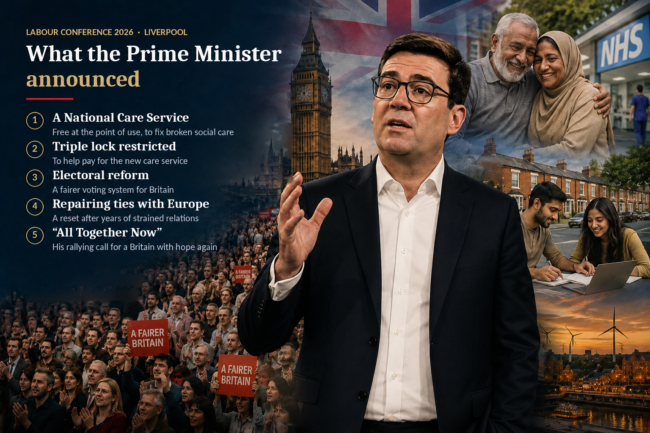
Perhaps the strongest part of Burnham’s speech was his focus on social care.
He announced his intention to create a National Care Service, based on the principle of high-quality, person-centred care that would be free at the point of use, with no care charges taken from people’s basic state pension.
This is not simply another government programme.
For millions of families, social care is deeply personal.
It is about parents and grandparents.
It is about people who have spent their lives working and contributing to Britain.
It is about families who suddenly find themselves trying to navigate a complicated care system when a loved one becomes vulnerable.
Burnham spoke personally about his own family experience of care and his grandmother’s experience of having to sell her home to pay for care.
That personal connection was evident throughout the speech.
He also spoke directly to care workers, acknowledging the difficult work they do and the fact that many have been poorly rewarded for years.
And when he turned to NHS staff, his message was equally direct: a failing social-care system places enormous pressure on the NHS.
That is a point worth understanding.
If people cannot get the care they need outside hospital, hospitals inevitably carry more of the burden.
Burnham’s argument is that Britain needs to fix both sides of that equation.
A difficult decision on pensions
One of the most politically significant announcements was Burnham’s decision to change the pension triple lock from 2030 if Labour wins the next election.
Under his proposed system, pensions would rise by whichever is higher inflation or 2.5 per cent – rather than also being linked to average earnings. The savings would contribute towards building the National Care Service.
This is undoubtedly a difficult political decision.
Burnham himself acknowledged that.
But what I found notable was his willingness to say openly that difficult choices sometimes have to be made.
He effectively told the country that if meaningful reform is to happen, politicians cannot simply avoid every difficult decision because it may carry a political cost.
That is an uncomfortable message.
But perhaps it is also an important one.
A message for Britain’s elderly
For the British Bangladeshi community, this part of the speech deserves particular attention.
Many of our parents and grandparents came to Britain decades ago.
They worked hard.
They built businesses.
They raised families.
They paid taxes.
They contributed to the communities around them.
Now many are reaching retirement age.
Questions about pensions, social care, housing and healthcare are therefore becoming increasingly important within our own community.
And our community has a strong tradition of caring for elderly relatives within the family.
A properly designed National Care Service could provide meaningful support to those families.
But it must also understand the diversity of Britain.
Culturally sensitive care, language support and respect for religious and family traditions should be part of the conversation.
If Burnham’s vision eventually becomes reality, Britain’s diverse communities should have a voice in shaping how that care system works.
A country where young people can build a future
Burnham also placed housing and opportunity firmly on the political agenda.
For many young people, owning a home has become increasingly difficult.
A generation of young adults is asking whether they will ever be able to achieve what their parents and grandparents once considered a normal part of adulthood.
That is not sustainable.
A successful country should give young people the opportunity to work hard, build careers, establish families and eventually own a home.
Burnham’s proposals on housing and social housing are therefore significant.
The challenge will be turning those ambitions into homes that people can actually afford.
But again, I welcome the fact that the issue is being placed at the centre of the political conversation.
Public services should serve the public
Burnham’s proposals for water and energy were another important part of his speech.
He announced plans to remove legal barriers to public ownership of water companies and begin what he described as a ten-year journey towards a very different water system. He also outlined plans for a publicly backed Great British Grid.
The underlying principle is one that I believe deserves serious discussion:
Essential services should ultimately work in the public interest.
Water and electricity are not luxuries.
Every household needs them.
Every business needs them.
Every community depends on them.
Whether public ownership is always the answer is a legitimate question.
But after years of frustration over water pollution, energy costs and infrastructure, I welcome the fact that the government is prepared to think differently.
Britain and Europe: looking forward
Another part of Burnham’s speech that particularly interested me was his approach to Europe.
He argued that Brexit had not delivered the level of control promised and said Britain needs to establish a new, long-term relationship with the European Union.
For me, this was not about reopening yesterday’s arguments.
It was about recognising tomorrow’s reality.
Britain is geographically, economically and historically connected to Europe.
We need a relationship that works for British businesses, workers, students and families.
After years of political division over Brexit, perhaps the time has come for Britain to discuss Europe with less anger and more maturity.
Politics needs to change too
Burnham also announced a national commission on electoral reform, with Labour intending to include electoral reform in its next manifesto.
Again, this is much bigger than party politics.
Britain’s democratic system has existed for generations, but the political landscape has changed dramatically.
The question of whether the voting system should better reflect the choices made by voters deserves a serious national conversation.
I welcome the fact that Burnham is prepared to have that conversation.
Why I called it a “People’s Prime Minister” speech
I know that calling Andy Burnham a People’s Prime Minister is a strong description.
But I am not using the phrase simply because I agree with every policy he announced.
I use it because of the way he spoke.
There was something human about the speech.
When he spoke about his father, who died only weeks ago, the emotion was impossible to miss.
He spoke about his grandparents, his family’s journey and the opportunities that previous Labour governments helped create for his generation.
At one point, he struggled to hold back tears.
It was not the polished political performance we have become accustomed to.
It felt personal.
It felt real.
And, for me, that matters.
Politics is ultimately about people.
Behind every statistic is a family.
Behind every policy is a human being.
Behind every government decision is someone’s life.
A message to our community
As British Bangladeshis, we should listen carefully when any Prime Minister sets out a vision for Britain.
Not simply because of party politics.
But because Britain is our home.
Our children were born here.
Our businesses operate here.
Our parents built their lives here.
Our communities have grown here.
We have a stake in Britain’s future.
We should therefore welcome ambition while continuing to ask questions.
Will young people be able to afford homes?
Will elderly people receive dignified care?
Will businesses be able to grow?
Will energy become more affordable?
Will public services improve?
Will Britain become more prosperous?
These are the questions that matter to our families.
Hope after years of division
What stayed with me most after Burnham’s speech was his message of hope.
Britain has experienced years of political division, economic uncertainty and public frustration.
It is easy to become cynical.
It is easy to believe that politics cannot change anything.
But Burnham challenged that idea.
His message was essentially that Britain can do better – and that government can still be a force for positive change.
I found that refreshing.
Of course, speeches are only the beginning.
The difficult work comes afterwards.
Policies have to be funded.
Promises have to be delivered.
Public services have to improve.
And people ultimately have to feel the difference in their everyday lives.
But every major political change begins with an idea and the courage to articulate it.
This week, Andy Burnham gave Britain his idea of where the country should go next.
The real test now
History will not judge Burnham’s speech by the applause he received in Liverpool.
It will judge it by what follows.
Can he build the National Care Service he has promised?
Can he strengthen public services?
Can he improve housing opportunities?
Can he make essential utilities work better for the public?
Can he rebuild confidence in politics?
Can he establish a more constructive relationship with Europe?
Those are enormous challenges.
But I came away from his speech with something that I have not felt often enough from British political leadership in recent years:
Hope
For me, this was more than a Labour conference speech.
It was a statement of belief in Britain.
A belief that politics can once again be about people rather than political games.
A belief that government can be ambitious.
A belief that difficult problems can be confronted rather than postponed.
And perhaps most importantly, a belief that Britain can still change for the better.
That is why I believe Andy Burnham’s speech will be remembered – not simply for what he promised, but for how he made people feel about the possibility of a better Britain.
After two decades in which political speeches have often left me cold, this one made me stop and listen.
It sounded, quite simply, like a Prime Minister speaking to his people.
Taz Choudhury – Columnist, Chief Editor, Bangla Post